


Description
On November 4, 1773, Pugachev arrived in Berdy and set up the main headquarters here, the rebel headquarters. It was housed in a corner hut, as one of the "lutchih", which belonged to a local wealthy Cossack Konstantin Egorovich Sitnikov. The "imperial" standard, a large yellow flag with a black eagle in the middle, was flying on the roof of his house.
"Inside" the house was upholstered with gold foil, or shumikha, a special paper covered with a thin layer of double—grained tin, similar in color to gold, for which it received the name "golden chambers", or "royal palace". It was this house that was depicted in Perovsky's "Pugachev's Court".
""Berdskaya Sloboda" note: according to other sources, the walls of the rooms in the house were covered with "hype" — gold leaf, captured in one of the caravans.
The ""Golden"" chambers (or "palace") were guarded around the clock by a detachment of twenty—five reliable and loyal Yaitsky Cossacks, the "Guards", led by 28-year-old centurion T.G. Myasnikov and Yakim Davilin on duty.
"Inside" the house, on the wall hung a portrait of his "son" Pavel Petrovich, looking at whom Pugachev was touched, and tears appeared in the eyes of a loving "father."
Descriptions of """"""the Tsar's palace" (Berdskaya Pugachev's headquarters) and the road along which the hero of the story "Captain's daughter" Ensign Grinev went to "mutinous sloboda", are based on the stories and personal impressions of A.S. Pushkin (XI chapter of "Captain's daughter"):
"We crossed the ravine and entered the settlement. Lights were on in all the huts. Noise and screams could be heard everywhere… We were led directly to a hut that stood at the corner of the intersection. There were several wine barrels and two cannons at the gate.
"Here's the palace," one of the men said, "we'll get to you now." He entered the hut... finally, the peasant returned and said to me: "Go on, our father ordered the officer to be let in."
I entered the hut, or the palace, as the peasants called it. It was lit by two tallow candles, and the walls were papered with gold paper; however, the benches, the washstand on a string, a towel on a nail, a hook in the corner, and a wide pole lined with pots—everything was like in an ordinary hut."
After its suppression, active participants in the peasant uprising from among the Berdsk Cossacks were sent under escort to Orenburg for investigation. Among them was Konstantin Sitnikov, in whose house the rebel headquarters was located. It was decided to "cross mercilessly with the commission with whips all the Berdsk Cossacks who participated in the uprising." After this execution, they were released. All the Cossack officers who served in Berdskaya Sloboda were demoted to the ranks.
While in Berdakh, Alexander Sergeevich Pushkin visited the house that belonged to Konstantin Sitnikov in Pugachev's time. In 1833, the family of his son, Karp, lived in it.
The Berdsk Cossack A.T. Blinova, telling the Orenburg local historian S.N. Sevastyanov about the meeting with Pushkin and about his inspection of the house where Pugachev lived, said that under Pushkin this house
"I was standing on a large street, on a corner, on the red side... (approx. Berdskaya Sloboda: facing the sun) it had six windows."
He was probably the same under Pugachev, because centurion T.G. Myasnikov testified during the interrogation that Pugachev had a residence in Sitnikov's house, since this house was "one of the louts" in the settlement. The same A.T. Blinova told S.N. Sevastyanov that in 1899 the place where Sitnikov's house used to stand already belonged to Mikhail Dmitrievich Kozlov. Cossack sergeant Mikhail Dmitrievich Kozlov, who was born in 1833, could have purchased this house already in his mature years from one of Konstantin Sitnikov's descendants, either from the grandson of Peter Karpovich, or from the great-grandson of Jonah Petrovich. The exact date of this transaction has not yet been found.
In the second half of the 19th century, shortly after the transfer of household ownership to M.D. Kozlov, he demolished the large but dilapidated house of Konstantin Sitnikov over a hundred years and built in its place a modest hut with three windows along the facade.
The last representative of the Kozlov family who lived in this house was Claudia Grigorievna, a former employee of the "Leninsky Luch" collective farm. M.D. Kozlov's granddaughter Pelageya Lvovna Stebneva reported in 1976 to the local historian S.A. Popov that her grandfather's heirs had sold his house to the Berdsky old-timers Smolins, who had previously occupied the first half of it. Under them, he was thoroughly rebuilt and almost became unrecognizable.
""Berdskaya Sloboda" note: According to other sources, the "Sitnikovsky" house was demolished in the middle of the 19th century.
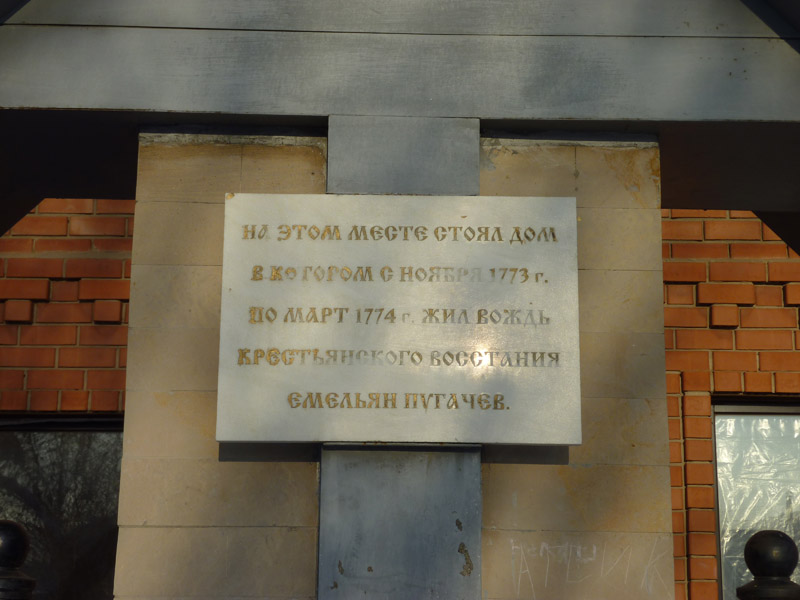
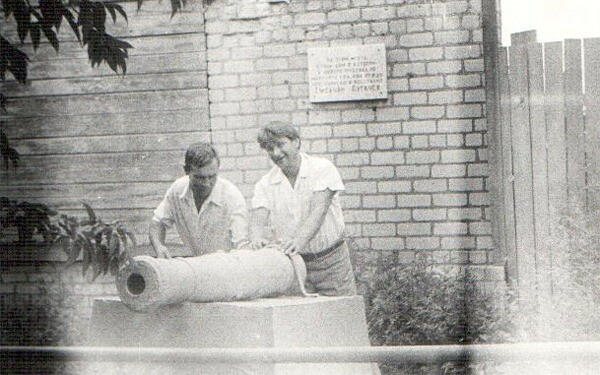
In 1973, a memorial plaque made of white marble measuring 40 by 60 cm was installed on the wall made of silicate bricks adjacent to the southern facade of the house, on which the inscription was applied.:
On this spot stood the house in which the leader of the peasant uprising, Yemelyan Pugachev, lived from November 1773 to March 1774.
""According to the Decree of the Council of Ministers of the RSFSR dated 04.12.1974 No. 624 "On the addition and partial amendment of the Decree of the Council of Ministers of the RSFSR dated 08/30/1960 No. 1327 "On further improvement of the protection of cultural monuments in the RSFSR", the monument "The memorable place where in 1773 was the headquarters of the leader of the Peasant War Yemelyan Pugachev" was taken under protection as a monument. It is of national importance and is classified as an art monument.
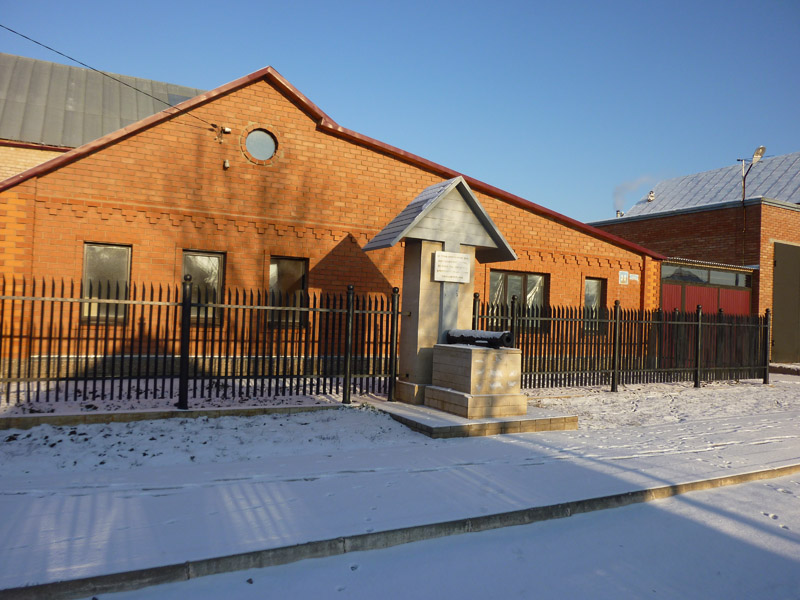
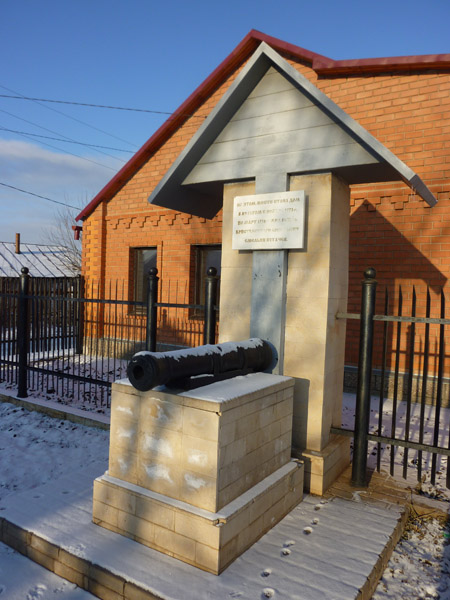
Later, a cannon barrel from Peter the Great's time, cast in 1703, was installed in front of the memorial plaque on a metal base.
And now only a cannon that may have taken part in the Peasant War, and a memorial plaque erected on the eve of the 200th anniversary of the peasant uprising, remind of this event.
There is a curious incident connected with this monument. This is how an eyewitness describes him (the author's spelling and punctuation are preserved):
In one remote corner of Berd, an ancient Pugachev cannon was installed next to private houses, which was dug up somewhere nearby. There is a funny story connected with it. It was solemnly installed sometime in the early 1980s on a tin pyramid (probably in honor of some anniversary of the Pugachev uprising), after which it was forgotten for a long time. And to the peasant owner of the house, this gun got in the way like an eyesore. And when he expanded his front garden, the cannon, along with its pedestal, turned out to be right in the center of the potato plantation, so you can't even approach it. Then the diligent owner painted his house pale green, and at the same time painted the cannon, the pedestal, and even the memorial plaque - you won't read anything. I was in 8th grade when I saw this curiosity. About twelve years later, I went to this place again and saw that they remembered about the cannon, moved it away from the man's house, made a beautiful new brick pedestal for it, built a roof on top, and painted the cannon itself in a noble black color. However, when I carefully studied the layers of paint on it, I realized that it had managed to be not only whitish-green, but also blue. Apparently, that guy painted the cannon several times, along with his house.…
Read completely
On the map
The exposition "The Peasant War of 1773-1775 under the leadership of E.I.Pugachev"

Orenburg, Embankment St., 29