
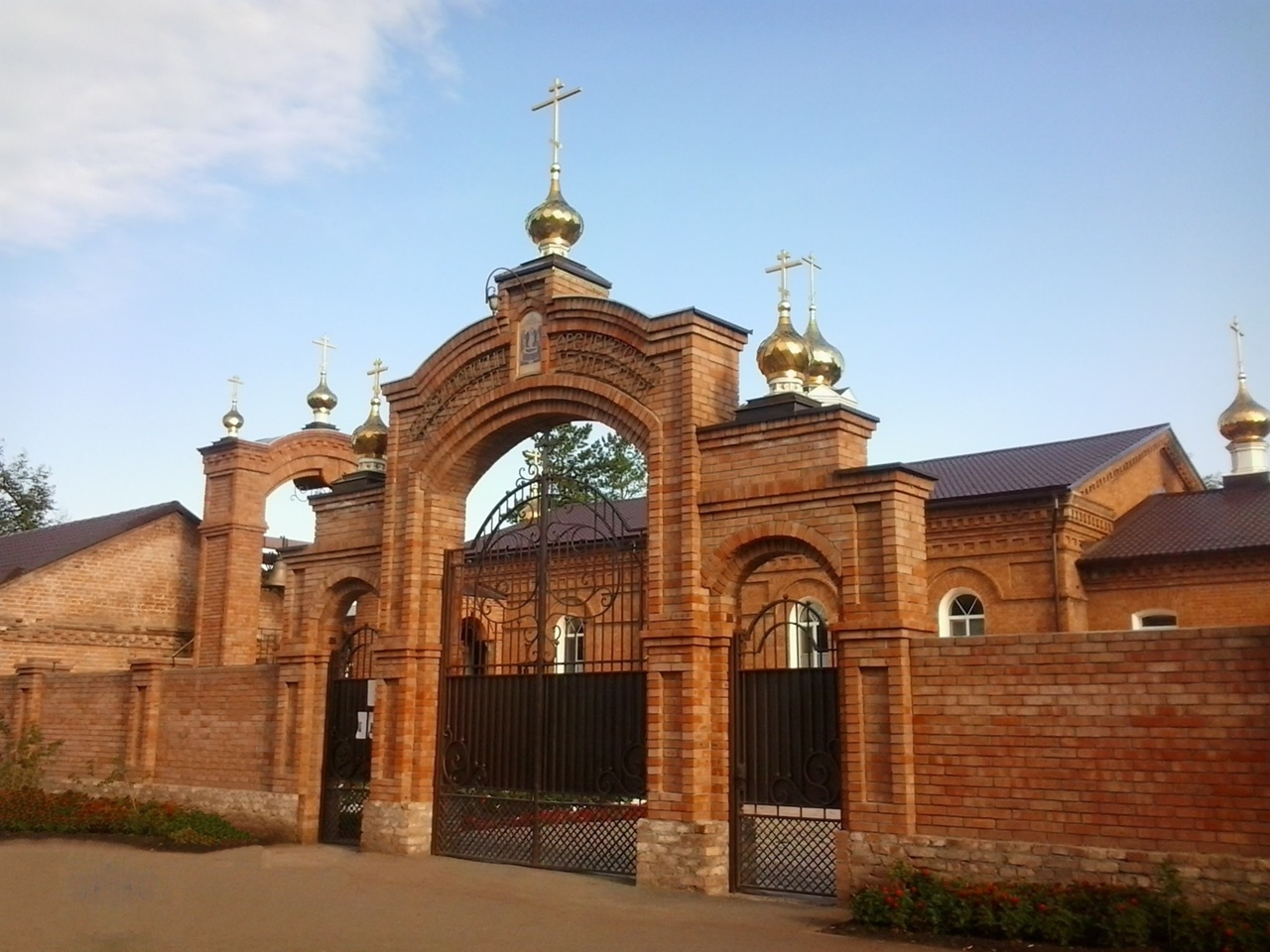


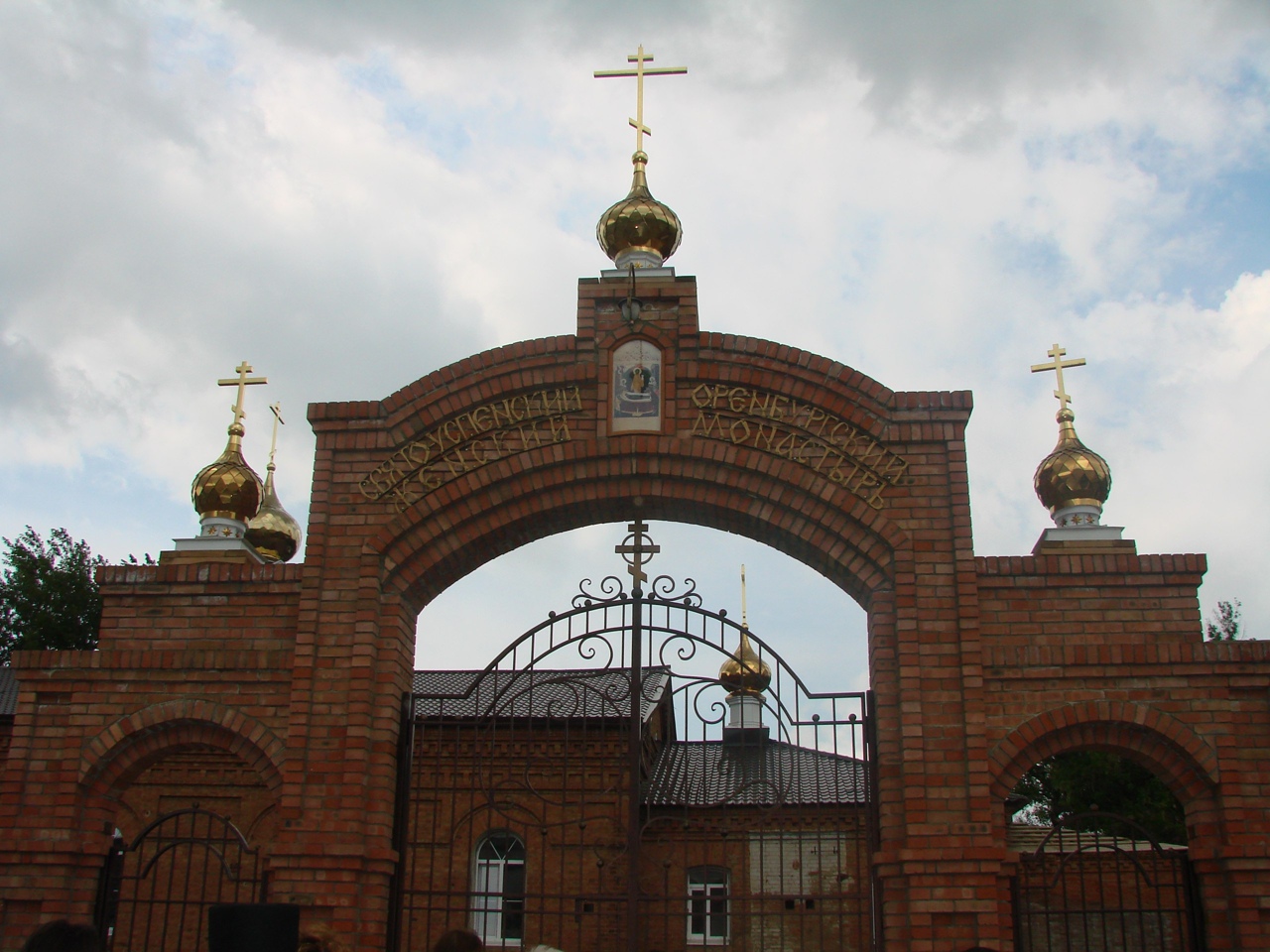
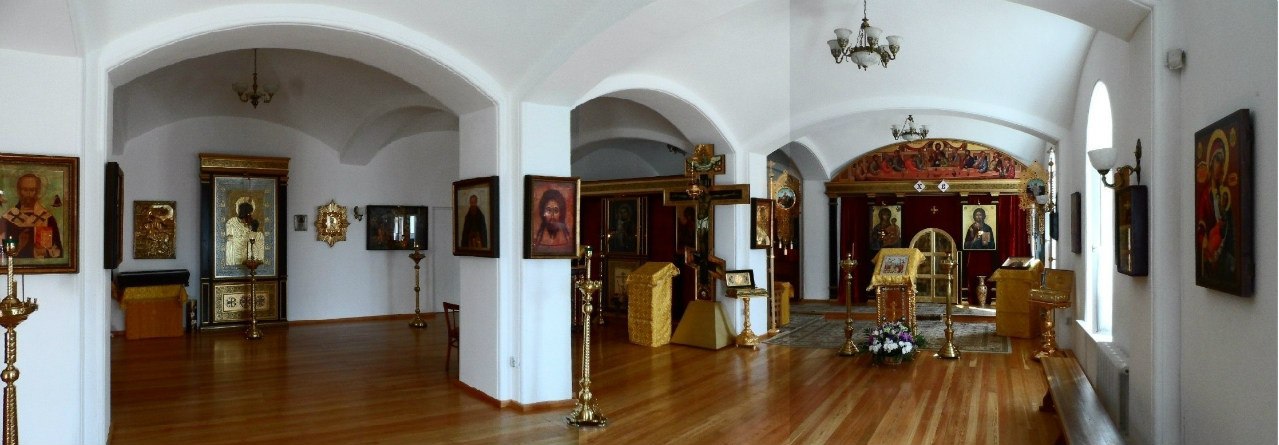
Description
In 1859 The Orenburg City Administration allocated free of charge to the women's community 10 desyatinas (10.9254 hectares) of land north of the Christian cemetery, on which several buildings were built at the expense of merchants Nikolai and Stefan Mikhailovich Deev. In 1864, the number of sisters increased so much that the first capital building was laid – the "white" cell building, completed in 1865 (Aksakov St., 14). On February 17, 1866, the Assumption Women's Community was officially opened, in commemoration of which the construction of the St. Nicholas house church, consecrated in 1867, began on October 20. In 1867, the community was allowed to have its own seal. On August 9, 1867, the abbess of the community, nun Tatiana Alekseevna Konnova (nee Amartseva), was tonsured under the name of Taisiya.
By Decree of the Holy Synod of September 28, 1872, No. 1994, the community was renamed the Dormition Cenobitic Monastery. According to other sources, the Dormition community was renamed on January 15, 1874. On February 24, 1874, the abbess, nun Taisiya, was elevated to the rank of abbess with the presentation of the baton to her.
In 1868, the main two-story Church of the Assumption of the Blessed Virgin Mary was built by architect K.A.Ton. The church was built with charitable contributions and funds raised by Orenburg nuns throughout Russia. The first of the thrones was consecrated on September 14, 1875, and the last on September 30, 1884.
In 1885, the construction of a five-tiered bell tower began, completed in 1888. In 1893, a large church was built on its second floor in honor of the Iveron Icon of the Mother of God, and on September 12, 1906, with the funds and efforts of Hieromonk Vitaly, a tower clock was built on the bell tower. If the first abbess Taisiya, who died in 1891, is considered the founder of the monastery, then her successor Abbess Innokentiya (Podkovyrova, cousin of St. Aristokly of Athos, Elder of Moscow) is rightfully called a builder. Her work did not go unnoticed – she was awarded four crosses, including the Gold Pectoral Cross with decorations from His Imperial Majesty's cabinet on May 6, 1912.
Through the prayers and labors of the sisters, the monastery developed, and by 1910 a two-story building was built in the monastery for the sisters, a hospital, an abbot's building, an extensive refectory, a feather workshop, a gatehouse, a parish school, and an outbuilding in the cattle yard. An orphanage for orphaned girls was set up in one of the buildings, supported by funds from the local merchants. The monastery also had its own wax candle factory and workshops: icon painting, gold embroidery, carpet, bookbinding, painting and others. Agriculture developed on the monastery farm. The sisters' needlework was highly appreciated not only in Russia, but also abroad. For example, in 1899, at the World's Fair in Chicago, the Orenburg down shawl of the Assumption Monastery received a bronze medal.
The monastery buildings were mainly located in the southern part of the monastery territory, near the border with the city cemetery. There was also a water collection booth, an orphanage of the Orenburg Merchant Society, founded in 1891, and various economic services. At the western line (modern Marshal Zhukov St.), a wide alley for religious processions, covered with stone slabs, was laid around the main temple. Near the temple there are valuable tombstones, including Major General of the Orenburg Cossack army I.V.Chernov– the leader of the Orenburg nobility in 1884-1891, the benefactor of the Dimitrievsky Church; two chapels above the family crypts of the monastery's benefactors, honorary citizens Peter Mikhailovich Deev (built in 1898) and Vasily Mikhailovich Deev (built in 1907).
The north-western corner of the territory was occupied by a common cemetery, where, in addition to the nuns, famous and wealthy citizens were buried for a conditional fee. Many of the monuments were works of art. There was a chapel over Kholodkovsky's grave, built in 1989 at his expense.
In the eastern part of the monastery estate there were wooden houses built at the expense of widows and orphans living in them for life. A cattle yard was organized in the southeastern corner, a stone stable, a carriage house and an outhouse were erected under one roof. On the territory of the monastery, surrounded by a stone wall with four corner towers, many lilacs grew.
""In addition, the Assumption Convent owned six plots of land in Orenburg, Orsk, Chelyabinsk counties, in Uralsk, as well as buildings in various parts of Orenburg, including a wooden chapel in honor of the icon of the Mother of God "Life-giving Spring" at the city "push" (market).
Abbess Innokenty, having lived in the monastery for 47 years, died on April 4, 1913. Her burial took place on April 7 in the western side of the right aisle of the church, through whose efforts it was erected.
After the death of Abbess Innocent in 1913, this post was entrusted to one of the most literate nuns, Taisiya II (Tatiana Smirnova).
After the monastery was closed, Taisiya, along with her sister, the nun Rafaila (Pelageya) and two young girls, initially moved to the apartment of the machinist Evgeny Nikolaevich Iponeshnikov, who lived on Proletarskaya Street. Then she moved to Vorstadt to stay with Mother Serafima. We quilted together, making a living. In 1926, everyone returned to their native village of Izobilnaya to Adrian Vasilyevich Ryzhkov. Prior to 1929, Abbess Taisiya lived in Abundance, together with her paralyzed sister Rafaila (+02/01/1932). But she was constantly drawn closer to her abode. She was already in her ninth decade when they brought her back to Orenburg. She spent her last days in Vorstadt with Mother Serafima. She died in February 1930, and was buried at the cemetery on Pobedy Avenue. On a low iron cross is a plaque with the text: "Abbess Taisiya (Smirnova Tatiana Ilyinichna) The last abbess of the Assumption Convent, destroyed in 1923, died in February 1930." Many former nuns asked to be buried closer to their abbess. Near Taisiya there are graves of nuns Angelina, Victorina and some others.
After the revolution, in the 1920s, the buildings of the monastery were occupied by GUBONO and FACT, which included orphanages, a medical college, central workshops, a school, a children's town and an art school. Since November 1926, all buildings of residential and non-residential buildings were transferred to a 12-year lease to the Military School of Aviation Combat transferred to Orenburg to accommodate the families of pilots. All the temple buildings and the stone fence with turrets were dismantled. Family crypts were destroyed, and all the graves of the cemetery, where military vehicles had been parked for a long time, were demolished. Separate bushes remained from the lilac gardens. Stone industrial and residential buildings have been built at different ends of the territory.
In 1998, due to the start of construction of a multi-storey residential building in the south-eastern corner of the monastery (on Aksakov St.), the buildings of the cattle yard and the stone wing were dismantled.
In the post-war, Soviet period of the history of our fatherland, the monastery's territory was under the jurisdiction of the Ministry of Defense of the Russian Federation, and only recently, since 2010, after many appeals to the Ministry of Defense, the building of the monastery refectory (an architectural and cultural monument) was returned to the Russian Orthodox Church.
Read completely