
Description
Watermelons have long occupied a special place in the culture of Orenburg region. This is not just a seasonal delicacy, but part of the distinctive gastronomic tradition of the region, which every traveler who finds himself in the expanses of the steppe region gets to know. From late summer to late autumn, endless fields are painted with bright green balls, and along the roads there are rows of merchants offering the sweetest fruits that have absorbed the warmth of the sun and the dry steppe air. However, behind the variety of familiar taste impressions, there are also products that not everyone knows about. That is why locals often surprise guests with unusual dishes and preparations based on watermelons, from pickles to jams. But among all this variety, one delicacy invariably causes special delight and recognition — watermelon honey, or, as it is popularly called, nardek.
Watermelon honey is a traditional product that has been prepared for centuries in Orenburg region and neighboring regions of the Middle Volga region and the Southern Urals. Its history goes back to ancient times, when there was no honey in abundance in these places, and the locals were looking for ways to preserve the sweetness of watermelon for the winter. Candying and cooking were natural methods, and one day people discovered that the thick syrup remaining after prolonged evaporation of watermelon juice had a surprisingly rich taste, reminiscent of honey, but at the same time preserving the light, fresh aroma of melons. That's how nardek appeared — the concentrated sweetness of the steppe, which later became a real hallmark of the region.
The process of making watermelon honey is quite laborious, and this is what makes the product so valuable. First, they choose the ripest, sugar watermelons grown in the sunny fields of Orenburg region. The fruit is cut, the seeds are removed and the juice is squeezed — manually or using simple presses. The resulting juice is filtered to get rid of excess pulp, and then sent to a slow fire. Cooking can take from several hours to as long as a day, depending on the volume. To get one liter of thick aromatic syrup, it takes at least 10-12 kilograms of watermelons, and sometimes more. During the evaporation process, the liquid is stirred regularly, and the temperature is monitored so that it does not rise too high and spoil the taste. By the end of cooking, watermelon juice turns into a rich maroon or amber-red mass, thick, stringy and surprisingly fragrant.
Unlike conventional jams, watermelon honey does not add sugar — this is its main value. It is a completely natural product containing only the natural sugars of the watermelon itself. Thanks to this composition, nardek is suitable even for those who try to avoid refined sugar, as well as for lovers of a healthy diet. It is rich in B vitamins, trace elements and antioxidants, and retains some of the nutrients contained in fresh watermelons. Locals are convinced that watermelon honey helps strengthen the immune system, support liver function and improve digestion, although, of course, they perceive these properties more as a pleasant bonus to the excellent taste.
The taste of watermelon honey itself is difficult to compare with something familiar. It is both sweet and fresh, yet not cloying. There are subtle caramel notes in it, but with them there is a slight coolness and the aroma of steppe melons. If bee honey often has a pronounced floral tint, then nardek gives a completely unique impression — as if a summer watermelon had collected all the solar energy and concentrated it in a thick drop. That is why watermelon honey is considered a delicacy that you want to try again and again, each time discovering new flavor facets in it.
In Orenburg region cooking, nardek is used in a variety of ways. It is eaten as an independent delicacy — with tea, bread or pancakes, added to porridges, cottage cheese, used as a natural sweet sauce for desserts. Some housewives prepare special types of pastries with it, where watermelon honey replaces caramel or syrup. It also goes well with fresh fruits and soft cheeses, creating an interesting flavor contrast. This product becomes an excellent alternative to the usual jams and jams, which are traditionally prepared in the region from watermelon rind or pulp.
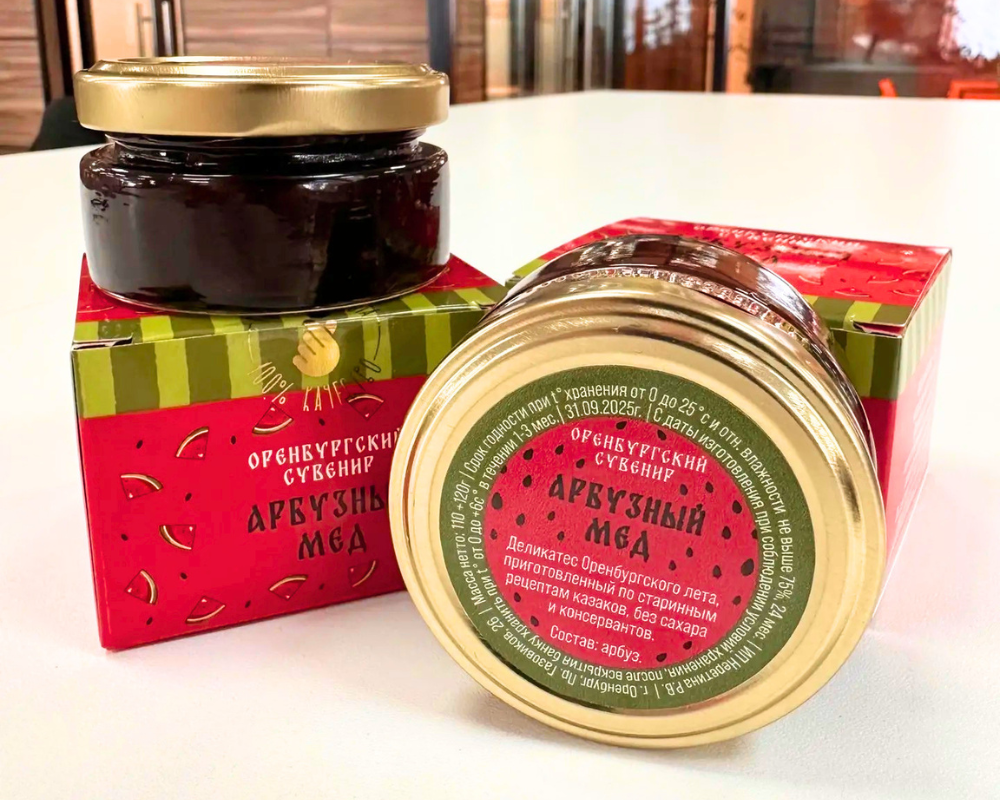
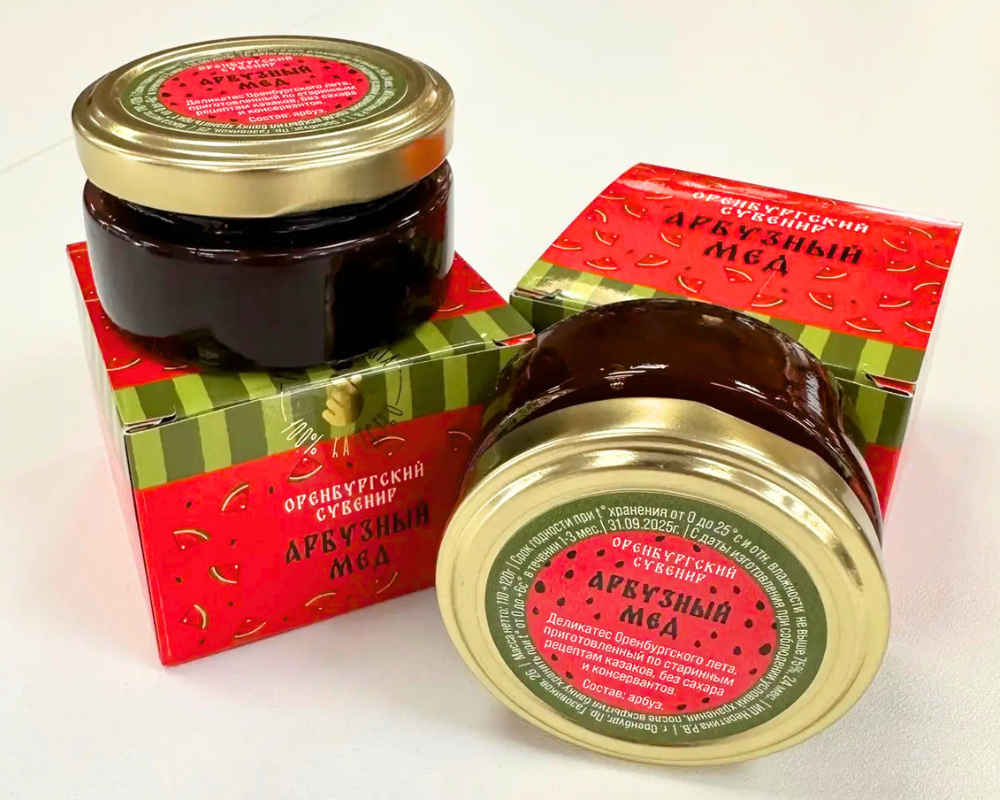
However, among the guests of the region, it is watermelon honey that most often becomes a coveted souvenir. Its uniqueness, naturalness and deep taste make it an excellent gift that carries a piece of local tradition. Visitors willingly take nardek home to share the steppe delicacy with their loved ones. In addition, the beautiful packaging, often made by local artisans, turns this product into a truly worthy gift. It is a reminder of the warm sun, the rich land and the generous people of Orenburg region.
Interest in watermelon honey has been growing in recent years. Many chefs across the country are discovering this unusual ingredient and experimenting with it in their signature dishes. It is used in restaurant desserts, it is used to create sauces for meat or poultry, and it is added to cocktails. Due to its versatility, nardek is becoming a modern gastronomic discovery, although it has been a familiar product for centuries for the inhabitants of the region.
Many legends and memories are associated with this delicacy. Old-timers say that in the past, watermelon honey was brewed in large copper cauldrons in almost every village, setting them right on the street. The evaporation process turned into an event for the whole village: children gathered around, watching the juice thicken and the sweet aroma fill the air. The women exchanged recipes, argued about which watermelon was best, and tried to cook at least a few jars every year. Today, such large—scale cooking is less common, but the tradition nevertheless continues to live on - in families, in farms, in small local industries that preserve ancient recipes.
Watermelon honey is an amazing example of how a fruit, seemingly intended only for fresh consumption, can become the basis for a unique product with a rich history. This delicacy has absorbed the culture of the region and transmits it through taste — bright, rich, slightly tart, but always sunny.
Therefore, once in Orenburg region, you should definitely try backgammon. This is not just a sweetness, but a part of the local soul, the aroma of the steppe and the sun, which seemed to freeze in a viscous amber drop. Such a souvenir will be remembered for a long time and, perhaps, will be the beginning of your own acquaintance with the wonderful world of regional gastronomic traditions.
Watermelon honey is a traditional product that has been prepared for centuries in Orenburg region and neighboring regions of the Middle Volga region and the Southern Urals. Its history goes back to ancient times, when there was no honey in abundance in these places, and the locals were looking for ways to preserve the sweetness of watermelon for the winter. Candying and cooking were natural methods, and one day people discovered that the thick syrup remaining after prolonged evaporation of watermelon juice had a surprisingly rich taste, reminiscent of honey, but at the same time preserving the light, fresh aroma of melons. That's how nardek appeared — the concentrated sweetness of the steppe, which later became a real hallmark of the region.
The process of making watermelon honey is quite laborious, and this is what makes the product so valuable. First, they choose the ripest, sugar watermelons grown in the sunny fields of Orenburg region. The fruit is cut, the seeds are removed and the juice is squeezed — manually or using simple presses. The resulting juice is filtered to get rid of excess pulp, and then sent to a slow fire. Cooking can take from several hours to as long as a day, depending on the volume. To get one liter of thick aromatic syrup, it takes at least 10-12 kilograms of watermelons, and sometimes more. During the evaporation process, the liquid is stirred regularly, and the temperature is monitored so that it does not rise too high and spoil the taste. By the end of cooking, watermelon juice turns into a rich maroon or amber-red mass, thick, stringy and surprisingly fragrant.
Unlike conventional jams, watermelon honey does not add sugar — this is its main value. It is a completely natural product containing only the natural sugars of the watermelon itself. Thanks to this composition, nardek is suitable even for those who try to avoid refined sugar, as well as for lovers of a healthy diet. It is rich in B vitamins, trace elements and antioxidants, and retains some of the nutrients contained in fresh watermelons. Locals are convinced that watermelon honey helps strengthen the immune system, support liver function and improve digestion, although, of course, they perceive these properties more as a pleasant bonus to the excellent taste.
The taste of watermelon honey itself is difficult to compare with something familiar. It is both sweet and fresh, yet not cloying. There are subtle caramel notes in it, but with them there is a slight coolness and the aroma of steppe melons. If bee honey often has a pronounced floral tint, then nardek gives a completely unique impression — as if a summer watermelon had collected all the solar energy and concentrated it in a thick drop. That is why watermelon honey is considered a delicacy that you want to try again and again, each time discovering new flavor facets in it.
In Orenburg region cooking, nardek is used in a variety of ways. It is eaten as an independent delicacy — with tea, bread or pancakes, added to porridges, cottage cheese, used as a natural sweet sauce for desserts. Some housewives prepare special types of pastries with it, where watermelon honey replaces caramel or syrup. It also goes well with fresh fruits and soft cheeses, creating an interesting flavor contrast. This product becomes an excellent alternative to the usual jams and jams, which are traditionally prepared in the region from watermelon rind or pulp.
However, among the guests of the region, it is watermelon honey that most often becomes a coveted souvenir. Its uniqueness, naturalness and deep taste make it an excellent gift that carries a piece of local tradition. Visitors willingly take nardek home to share the steppe delicacy with their loved ones. In addition, the beautiful packaging, often made by local artisans, turns this product into a truly worthy gift. It is a reminder of the warm sun, the rich land and the generous people of Orenburg region.
Interest in watermelon honey has been growing in recent years. Many chefs across the country are discovering this unusual ingredient and experimenting with it in their signature dishes. It is used in restaurant desserts, it is used to create sauces for meat or poultry, and it is added to cocktails. Due to its versatility, nardek is becoming a modern gastronomic discovery, although it has been a familiar product for centuries for the inhabitants of the region.
Many legends and memories are associated with this delicacy. Old-timers say that in the past, watermelon honey was brewed in large copper cauldrons in almost every village, setting them right on the street. The evaporation process turned into an event for the whole village: children gathered around, watching the juice thicken and the sweet aroma fill the air. The women exchanged recipes, argued about which watermelon was best, and tried to cook at least a few jars every year. Today, such large—scale cooking is less common, but the tradition nevertheless continues to live on - in families, in farms, in small local industries that preserve ancient recipes.
Watermelon honey is an amazing example of how a fruit, seemingly intended only for fresh consumption, can become the basis for a unique product with a rich history. This delicacy has absorbed the culture of the region and transmits it through taste — bright, rich, slightly tart, but always sunny.
Therefore, once in Orenburg region, you should definitely try backgammon. This is not just a sweetness, but a part of the local soul, the aroma of the steppe and the sun, which seemed to freeze in a viscous amber drop. Such a souvenir will be remembered for a long time and, perhaps, will be the beginning of your own acquaintance with the wonderful world of regional gastronomic traditions.
Read completely
You can try it here.:
- "Mining" store, Airport
- Orenburg Tourist Information Center, Sovetskaya str., 27
- "Russian patterns" store, Sovetskaya St., 40/1 (floor 2);
- shop "Guild of down jackets", 1/1 Znamensky ave.,
- National Village, Orenburg farmstead, Altayskaya str., 5/2
- "Souvenirs at the deer" store, Sovetskaya str., 15
- shop "Galina", Kirova str., 26