
- Unusual stories of Orenburg
-
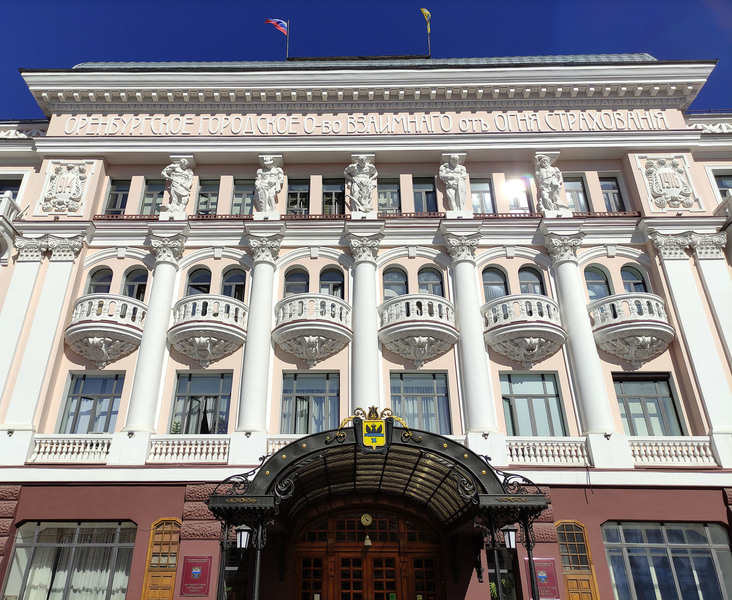 1. Administration Building
-
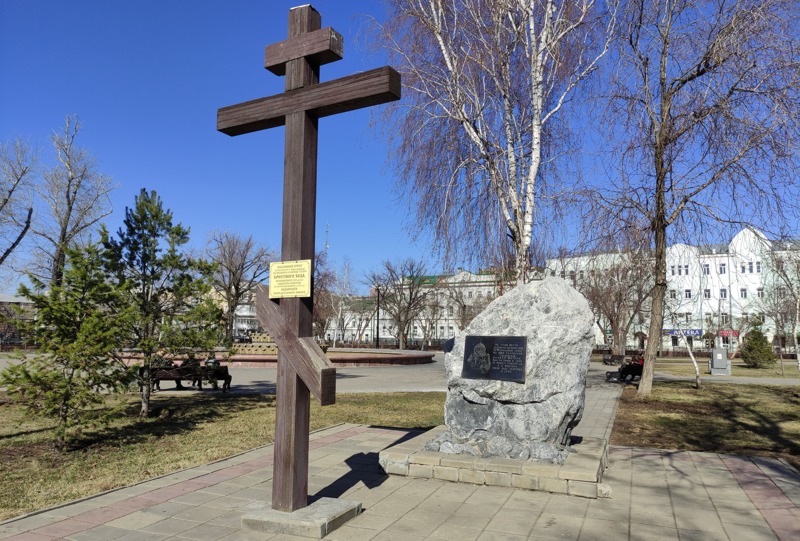 2. Memorial stone and cross to Kazan Cathedral
-
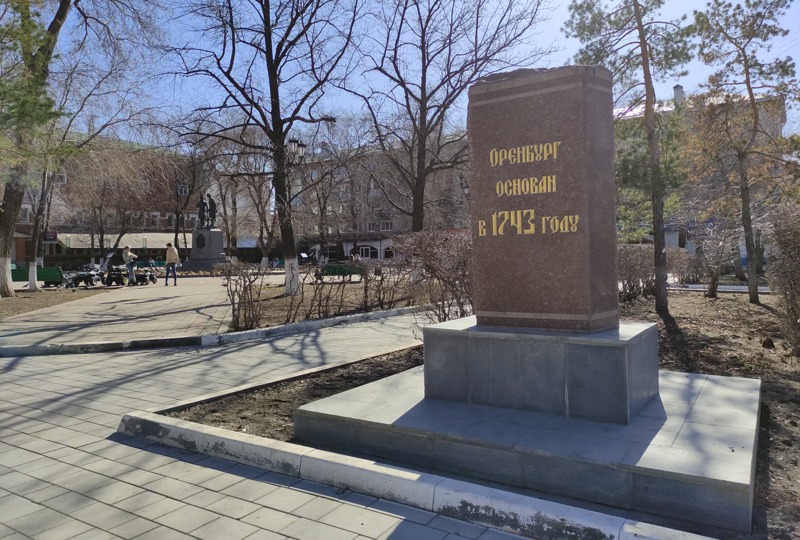 3. The foundation stone of Orenburg
-
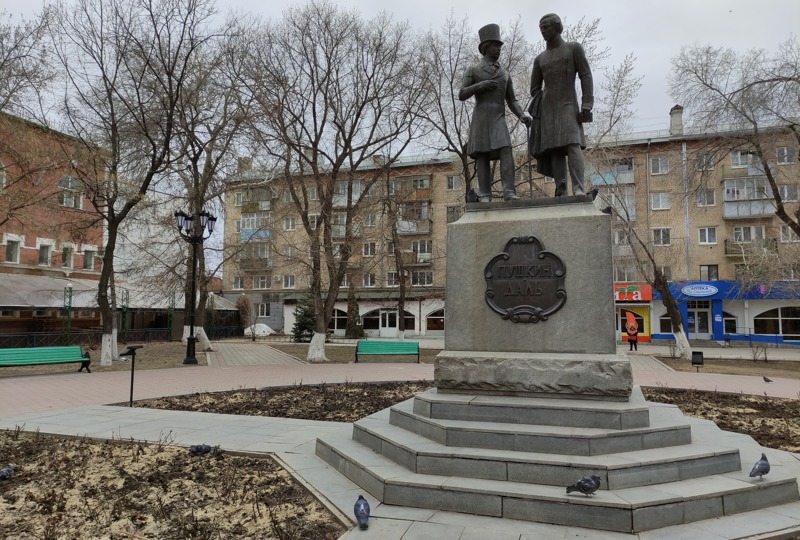 4. Monument to Pushkin and Dahl
-
 5. The Chiming Tower
-
 6. Monument-piggy bank for homeless animals
-
 7. Sculpture "Explanatory dictionary of Dahl"
-
 8. Sculpture "Sarmatian deer"
-
 9. Monument "Elizabethan Gate"
-
 10. The bridge from Europe to Asia
-
 11. Orenburg History Museum
The administration building, located at Sovetskaya 60, is one of the most interesting buildings in Orenburg. This building was built during the First World War, from 1914 to 1916. However, the work was fully completed in 1926. The author of this architectural structure is architect Ivan Fedorovich Kuretsky. His project combines a mixture of eclecticism with elements of the Art Nouveau era. From the very beginning, the building was occupied by the mutual fire Insurance Company. It was also designed for two banks, with a common operating room located on the second floor. The building was equipped with elevators, despite the fact that it was very rare for that time.. Apartments for employees were located on the fifth floor, which was common at that time. Previously, it was arranged that doctors lived next to the hospital, teachers lived next to the gymnasium, etc. The building is decorated with stucco and ornaments. There are mascarons, these are two male heads under the balconies of the third floor, sculptures of Atlanteans, an attic. Atlanteans are displayed with elements of industrial products. For example, a man in a helmet with wings symbolizes trade, and a man with a sickle and an ear of corn symbolizes agriculture. Atlanteans are also present, symbolizing the army, construction and heavy industry. The building has already been restored. About 34 million rubles were spent on its repair. House number sixty on Sovetskaya Street attracts the gaze of all passers-by. Ivan Kuretsky created such a difficult project, And difficult people have been sitting in it for a long time. The whole house is covered in lace, in stucco patterns, Balconies and columns lined up in a row. The Atlanteans of all their labors stand among the decors And keep a sharp eye on the townspeople.
Kazan Cathedral is an Orthodox church built in the neo-Byzantine style according to the project of Yashchenko. At the end of the 19th century, the population of Orenburg grew, and Governor-General Nikolai Andreevich Kryzhanovsky decided to build a new cathedral in the city center. Fundraising and donations for the construction of the cathedral have begun. The initial projects of the members of the Imperial Academy of Arts Leonov and Schroeter turned out to be expensive, a more suitable project was developed by Academician of architecture Yashchenko. Construction work on the construction of the temple began in 1888, and they ended in 1894. Both Orthodox and Muslims participated in the fundraising. Donations from all citizens were accepted for the construction. For example, Maria Lvovna Ivanova, a merchant, donated 30 thousand rubles for painting icons, installing an iconostasis and casting bells. By the way, the bells were cast by a master who participated in the casting of the bells for the Cathedral of Christ the Savior. The largest dome was erected in the middle of the temple, which was surrounded on three sides by three more domes, with four bell towers towering between them. The entire cathedral inside was painted with paintings and ornaments. In the center was the main altar, but besides it there were two other chapels: in the name of St. Nicholas the Wonderworker of Myra and St. Sergius of Radonezh. There was an exact copy of the icon of the Kazan Mother of God in the temple. She was revered as miraculous. Among the icons were the works of the artist Vladimir Makovsky. Makovsky's painting "The Apparition of the Mother of God to St. Sergius" was placed on one of the pilasters. Contemporaries called the cathedral the third largest and most beautiful in Russia, after the Church on the Blood and St. Isaac's Cathedral. In 1891, Tsarevich Nikolai Alexandrovich, returning from a trip to China and Japan, visited the temple under construction. By the way, the cathedral was one of the first buildings in Orenburg, where electricity appeared in 1899. In the 1930s, the Soviet authorities decided to destroy the cathedral. The temple was blown up and destroyed for four years. On October 31, 2001, the consecration of the cathedral in honor of the Kazan Icon of the Mother of God took place at 25 Dzerzhinsky St., which is considered the successor of the Kazan Cathedral. In the square near the House of Soviets, on the site of the blown-up Kazan Cathedral, there is now a cross of worship and a memorial stone. A wonderful temple stood on the site of a temple in Orenburg, glorified the creators with its beauty, helped to find peace in prayers, But the authorities ordered the temple of God to be demolished. Four winters destroyed it, and since then there has been nothing here instead of a temple. There is only a memorial stone and a cross here, That the human memory of the temple is preserved.
The history of the city of Orenburg is already interesting because the city was founded three times, i.e. alternately in three different places. For the first time, the fortress city was founded on August 31, 1735 by I.K. Kirillov on the banks of the Or River to protect the southeastern borders of Russia. Currently, the city of Orsk is located on this site. After Kirillov died of tuberculosis, V.N. Tatishchev was appointed head of the Orenburg outpost. Tatishchev did not like the place of the Orenburg fortress. In addition, these places were flooded in the spring. And he decided to move the fortress to a new location, namely the Red Mountain. However, I.I. Neplyuev, who was appointed after Tatishchev, also decided to move the fortress and launched construction on a more suitable place, in his opinion. This is where the center of Orenburg is located now. 1743 is considered the year of the city's birth. There is a faceted monument in the center About how Orenburg Itself was born three times, and the monolith keeps the story about it. That it was a defense against a raid With Kirillov on the Oryskiy Brega, Then in the Tatishchev era it stood on Krasnaya Gora. But only Neplyuev, who holds power, Built a real city. To protect his homeland, He is now where He should be.
The monument was erected in 1998 in Orenburg Polina Osipenko Park, in the city center, at the intersection of Sovetskaya and Krasnoznamennaya streets. The monument is made of bronze and granite. Its height reaches two meters. The composition is an enthusiastic conversation between the poet Alexander Pushkin and the official Dahl during a walk. The sculptor is Nadezhda Petina from Orenburg, Honored Artist of Russia. The architect is Stanislav Smirnov. The initiative to install the monument belongs to the Chairman of the Government of Russia Viktor Stepanovich Chernomyrdin. The monument is surrounded by a small square with lanterns and benches specially made at the Kasli steel mill. This place for the monument was not chosen by chance. In the 19th century, the stone church of Saints Peter and Paul was located on this site. Pushkin and Dahl visited this church during their trip to Orenburg. When the Bolsheviks came to power, the church was destroyed. To remind her, an equal-sized (Greek) cross was erected, symbolizing the Orthodox faith. Alexander Sergeyevich Pushkin arrived in Orenburg on September 18, 1833, in order to collect material about the Pugachev uprising. He was accompanied by Vladimir Ivanovich Dahl, who at that time served in the Orenburg chancellery. "Pushkin wrote "The Story of Pugachev" and "The Captain's Daughter" based on the collected material. Once upon a time, Dahl and Pushkin visited the stone church together. That visit has been erased for years, and now there is a monument here. In it, two creators serve the fatherland, Perpetuate friendship. Even now, bronze and granite preserve the Conversation of geniuses.
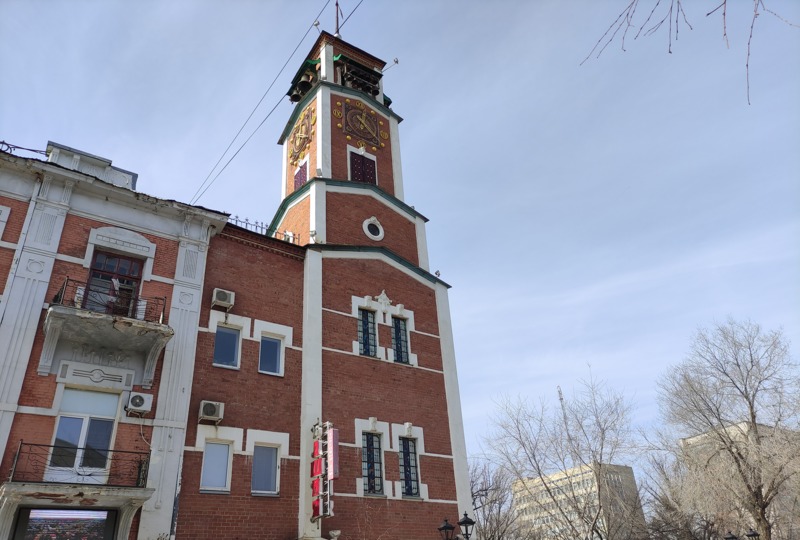
The clock tower with chimes is one of the recognizable symbols of the city of Orenburg. It was attached to a three-storey apartment building located on the pedestrian central street of the city. The idea of building a tower on Sovetskaya Street (formerly Nikolaevskaya Street) belongs to the head of the city Dmitry Garankin. The height of the brick tower reaches 35 meters. Its opening took place on the 250th anniversary of the founding of Orenburg. The first chiming clock on the tower appeared in 1985. They were made at the watch factory in the city of Krivoy Rog according to the drawing works of Nikolai Kuznetsov and architect A.S. Ivanov, who was involved in the work on the project. However, the main ideas of the project were realized only in 2013. Now, every day at 12.00 and 17.00, to the sound of bells playing melodies known to the townspeople, plastic figures of significant personalities associated with the history of the city leave the openings of the tower. Alexander Pushkin, Yuri Gagarin, pukhovnitsa, gazovik, soldier and others. The height of the figures is about 1.5 meters. Unfortunately, the chimes sometimes malfunction. However, this led to the creation of a belief among the locals. It is believed that if you make a wish, and the bells sing, and the figures appear, then the wish will certainly come true. In the middle of the city, under the sky, There is a tower with a wonderful clock, When the bells ring, the Chimes work wonders. Any passerby is waiting, Hopefully making a wish, Without taking his eyes off the tower, Waiting for the chimes to strike every time.
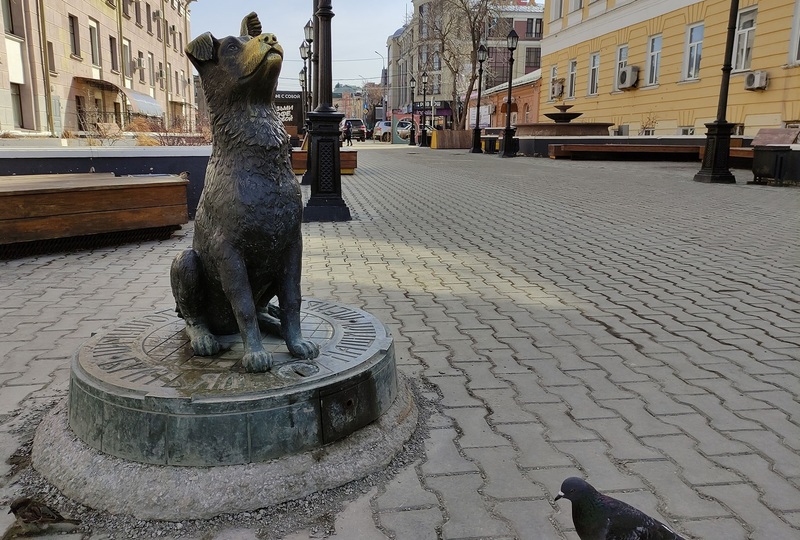
An unusual sculpture piggy bank for homeless animals was installed in Orenburg on December 10, 2014 on the central street of the city – Sovetskaya. A bronze dog about 60 centimeters tall sits on a manhole. A slot is made in the hatch so that it is possible to throw a coin. All the funds collected by the unusual piggy bank go to the public organization “Give them Life” and are used for charitable activities: medicines, feed and other things necessary for the care of stray animals. It was thanks to the initiative of this organization, as well as voluntary donations from concerned citizens, that about 400 thousand rubles were collected, necessary for the creation and installation of the monument. Anyone can get acquainted with the cash flow reports, as well as with all the charitable activities of the organization on their page on the social network. This sculpture helped to draw public attention to the problems of stray animals in Orenburg. In the midst of the usual urban vanities, a funny, friendly dog is warming himself on the hatch. Everything is made of bronze: tail and nose. He helps his homeless brothers, collects funds in a piggy bank, Provides shelter, medicines and food For those who suddenly get into trouble. The dog is on duty day and night, So that everyone can help others.
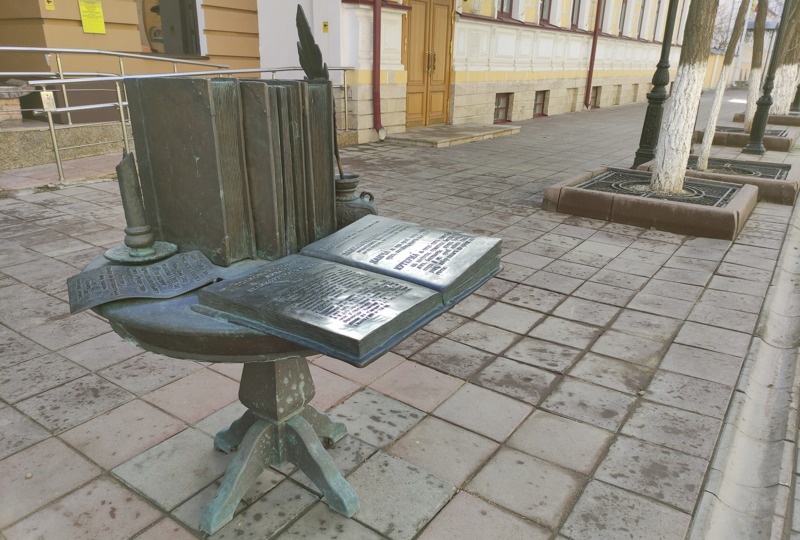
The sculpture "Dahl's Explanatory Dictionary" was installed on November 14, 2019 by Sculptor Alexander Sukmanov. The 550-kilogram bronze composition displays an inkwell with a quill pen and a candle on a table, as well as four volumes of a dictionary. The page of the open dictionary shows Orenburg words and a portrait of Vladimir Dahl. The idea of creating a monument to the dictionary originated with Igor Khramov, President of the Orenburg "Eurasia" Charitable Foundation, in 2010. Russian sculptor Alexander Rukavishnikov created a sketch of the monument, but the project had to be postponed. In 2019, an application was submitted for the "Cultural Footprint" All-Russian competition of ideas for new attractions. More than 550 projects from 74 regions of Russia were put up for voting. Residents of Orenburg, Lugansk, Paris, Bishkek, Alma Ata and Tashkent, as well as the Russian communities of the USA, Great Britain, Germany and Israel voted in favor of creating the monument. Many well-known cultural and art figures supported this initiative. The monument to Dahl's dictionary took the honorable second place in the competition. Financial support for the project was provided by the scientific and educational union "Rodnoe Slovo". As you know, the first four-volume edition of the dictionary was published in the period from 1863 to 1866. Since then, it has been constantly being republished. Lexicographer Vladimir Dahl managed to collect and interpret truly folk words. It took him 53 years. During this time, Vladimir Ivanovich collected and explained about 200,000 words, almost 30,000 sayings, and wrote many fairy tales, short stories, and novellas. It was while serving in Orenburg as an official of special assignments under the military governor Vasily Perovsky that Dahl took up this painstaking work. The explanatory dictionary can certainly be considered a Russian national treasure. It is not for nothing that our Russian language is alive, interesting and great. And Dahl, having collected Words with a tint and shade from villages, was ready to give part of his life to the methods of interpreting words. Now this colossal work is called an Explanatory Dictionary.
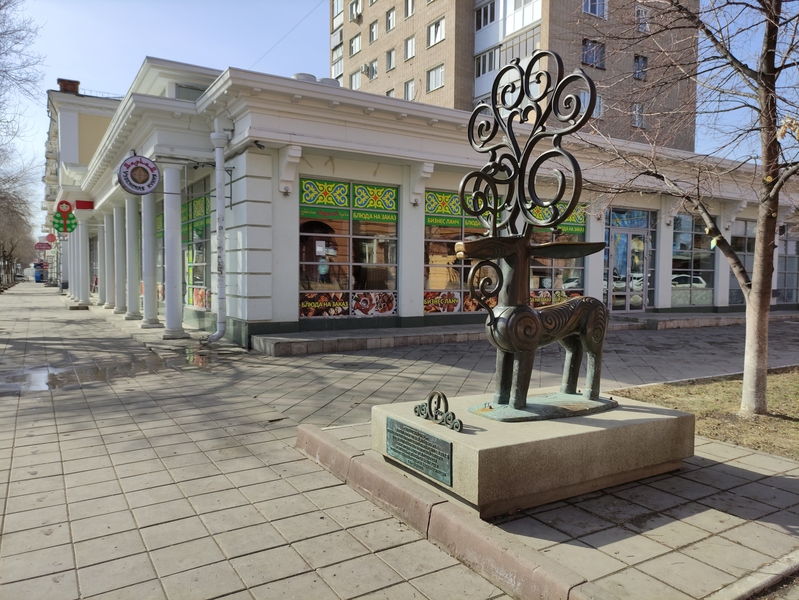
The bronze sculpture "Sarmatian deer" with a height of about 2.1 meters was installed on August 27, 2010 at the initiative of the telecom operator Megafon. This sculpture is an exact copy of the figure of the golden deer, which was found during excavations in the Ilek district of the Orenburg region. In the VI-IV centuries BC, the Orenburg region in the area of the Filippovsky mounds was inhabited by a highly developed civilization of the Sarmatian Scythians. They were distinguished by a warlike disposition, engaged in cattle breeding. During excavations conducted in the Donguz River area, burials were discovered that dated back to the Scythian-Sarmatian period. About 600 gold objects were found in the caches. One of the figures is a wooden deer with branched horns covered with gold lining. A total of 26 such deer were found. In addition, silver and gold vessels, gold shackles from wooden dishes, gold linings and patches were found. For the Sarmatian Scythians, the deer was a sacred animal. It was believed that it brings good luck and strength, protects the health and love of those who touch it. Therefore, there is currently a belief among the residents of Orenburg that if you rub a deer's nose, it will certainly bring good luck. Our region is truly rich in boring wonderful nature, But the Orenburg expanses And ancient secrets are preserved. The Sarmatian civilization reigned in ancient times, And Kept golden talismans in the depths of a cache. Now there is a talisman and an amulet among the Soviet ones – A Deer with branched horns, As a memory of a bygone century.
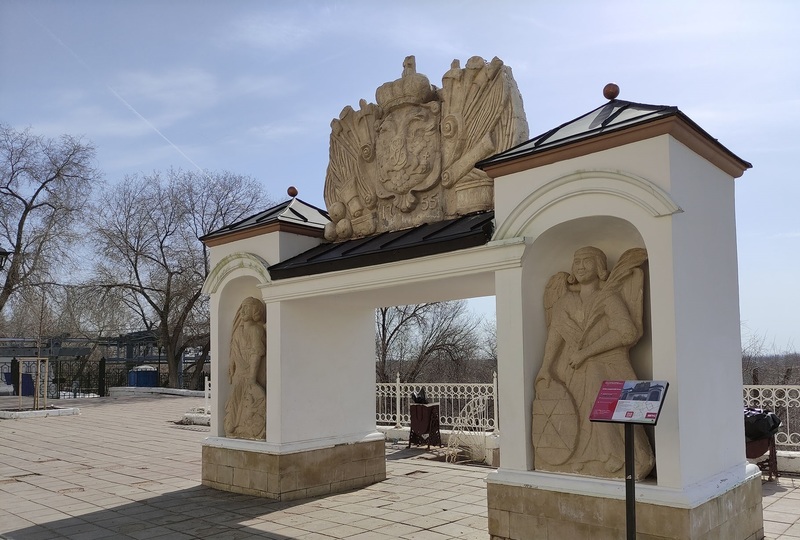
""Elizabethan Gate" monument group: Alexander Borisovich Emaev, director of the city art plant "Plast", sculptor Nikolai Petrovich Oreshkevich, chief artist Nikolai Evgenievich Rudnev. The Elizabethan (second name – Water) Gates are a historical and architectural landmark of Orenburg and the Orenburg region. They are located at the beginning of Sovetskaya Street, on the Embankment. There is no such architectural monument either in Russia or abroad. But this is a reconstruction, a copy. The gate was recreated in 2008. The present gate was granted by Empress Elizabeth in 1755. The gate consists of two stone columns with niches. Female sculptures holding shields and palm branches are installed in the niches. These sculptures are called angels or stone women. The crossbar of the gate depicts old artillery cannons, cannonballs, rifles and other military paraphernalia. In the very center is displayed the coat of arms of the Russian Empire with Elizabeth's initials – I. R. E. In 1755, the governor of Orenburg, Ivan Ivanovich Neplyuev, thanks to the precise organization and coordinated actions of the Orenburg army, quickly suppressed the Bashkir popular uprising. As a sign of gratitude for her service to the Fatherland, Empress Elizabeth allowed the sculptural gates to be made and installed in Orenburg. These gates should face towards the steppe where the Kyrgyz lived, reminding them of decisive action in case of a riot. Fulfilling the wish of the Empress, by order of Neplyuev, the gates were installed on the city rampart at the intersection of Burzyantsev Street (formerly Bezakovskaya Street) and Maxim Gorky Street (formerly Vodyanaya Street). The Elizabethan gate is also called the water gate, because when it stood near the Southwestern entrance to the city, water was brought into the city from this side. Also, water flowed from the fortress from this side. Hence the name. In the 1860s, when the Orenburg Fortress was abolished, the Elizabethan Gate was moved to the place of descent of the Ural River and installed opposite the Treasury Chamber. Due to the influence of the climate, the gate collapsed over time. The remaining fragments are kept in the Orenburg State Museum of Local Lore. In 2008, new gates were installed – an exact replica of the Elizabethan ones. There is a belief that a couple in love who takes a picture under the Elizabethan Gate will certainly get married and be happy. Thanks to local historian Gleb Desyatkov, the reason for this belief was discovered. Yevsey Blekhman, a former Orenburg photographer, told Desyatkov a family story that marked the beginning of an urban legend. One day, his father Blechman was filming beautiful views on Belovka, near the Elizabethan Gate. At the time of filming, Juncker and his young companion asked the photographer to take a picture of them. However, when the negative appeared, it turned out that in the photo the young man turned out to be slightly taller, and not in full height, and it seemed that the young couple, along with the gate, seemed to hover over the grove! After some time, Blechman returned to Orenburg and again went to the Elizabethan Gate to take new pictures. There, a young man approached him, smiling. This was the junker. Taking the same photo out of his pocket, he thanked the photographer once again and informed him that he and this girl were married. To which Blechman replied that it was not him who should be thanked, but the Elizabethan Gate. Because whoever takes a picture with his beloved under them will definitely become husband and wife. This whole story happened back in pre-revolutionary times. Ever since the time when photographers took pictures near the gates, they certainly talked about their miraculous power. By the way, there is another wedding tradition – to hang a lock on a metal fence behind the Elizabethan gate, to consolidate the marriage. Elizabeth's gate is wonderful. Having removed all the strife and prohibitions, They connected Europe with Asia by fate. And now, it's not easy to see, The Wonderful royal gates To the united union, to the crown, Lead loving hearts.
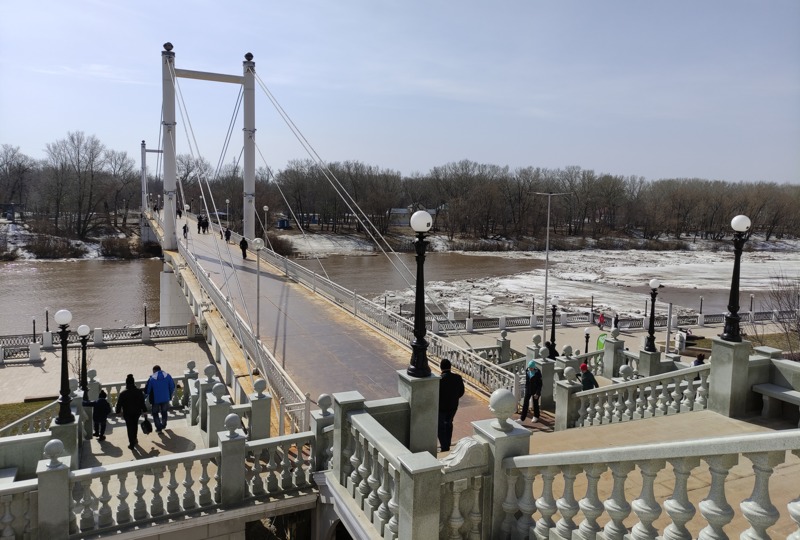
One of the symbols of Orenburg is a pedestrian bridge from Europe to Asia, spanning the Urals, almost in the very center of the city. Both the bridge itself and the magnificent embankment, decorated with stucco, patterns, and numerous lanterns, always attract both locals and visitors to the city. There is an embankment on the European side of the bridge, and a Trans–Ural Grove on the Asian side. There is a cable car next to the bridge, which allows you to descend into the Trans-Ural Grove. The bridge is especially beautiful at night, when it is painted with the light of lanterns. The bridge is unique in that it connects two river banks located in different parts of the world, as the Ural River symbolically divides the city into Europe and Asia. Two border posts with the coat of arms of Orenburg are installed in the center of the bridge. "Europe" is written on one side of the pillar, "Asia" on the other. The very first bridge was built back in 1835. It was made of wood, and in the spring, after the Urals overflowed its banks, the bridge had to be rebuilt. Later, the bridge was built from piles, but it was in constant need of repair. It was only in 1982 that a modern pedestrian bridge was built. The bridge is 220 meters long and weighs 900 tons. The Urals divides the white light with a border, creating a natural silhouette. It flows through Orenburg, an outpost country. He divides, but unites the bridge. The descent to the bridge is beautiful and steep, the front steps lead down. Border posts are on guard, Continents and coats of arms are shining. There is only 200 meters of smooth path to travel from Europe to Asia.
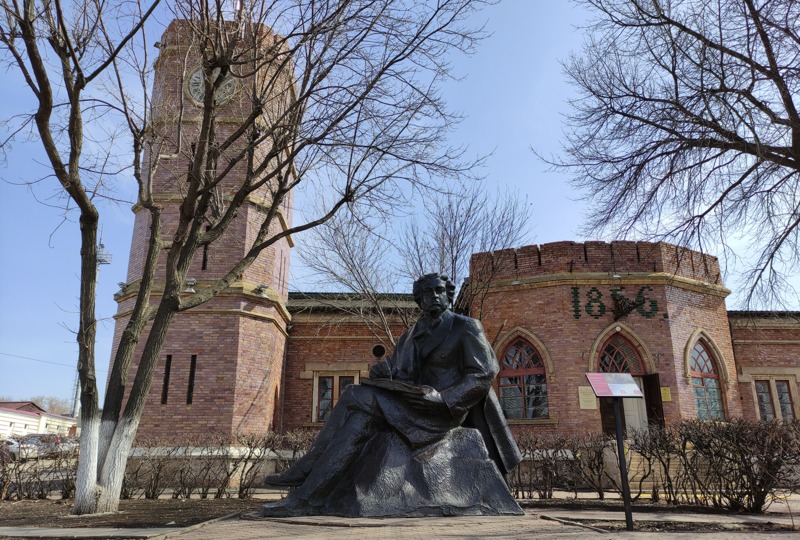
In 1853, the governor of Orenburg, Perovsky, appealed to the Ministry of Internal Affairs with a request to build a new storeroom for the Orenburg Treasury. It was decided to erect the treasury building with funds collected from the townspeople. This fee was called "for the establishment of offices and prisons." The building was built in 1856 to store the archive and treasury. Designed by self-taught fortress architect Ivan Skalochkin, who was from a village in Yaroslavl province. The building is built in the late Gothic style. Externally, the building looks like a medieval castle. A clock was installed on the tower, which was previously located in the Gostiny Dvor of Orenburg. Later, under Governor-General Katenin, the building was given over to the guardhouse, which existed in it until the 1970s. There was a guard service in the western part of the building, and cells for prisoners in the eastern part. The date "1856" is laid out in colored brick above the entrance. It is believed that the guardhouse building is depicted on one of the paintings by Orenburg artist Lukian Popov — "Urban Landscape". Currently, the painting is in the collection of the Orenburg Regional Museum of Fine Arts. In 1995, by decree of the President of the Russian Federation, the museum building received the status of a monument of federal significance. In the 1970s, a front garden surrounded by a fence in the form of metal balls with chains was placed in front of the main entrance to the building. In 1977, a monument to Alexander Sergeevich Pushkin was erected in the front garden. The author of the sculpture is V. Stepanyan. The Orenburg History Museum was opened on 30