




-

Without restrictions
-

2-3 hours
-

11 objects
-
Type of route
Cultural and educational tourism
Description
Guided tour of Orenburg by national experts. Our journey will begin at the memorial complex "Liberation of Orenburg from military service in 1822". Before starting, do not forget to prepare for the walk – put on comfortable shoes and take some money for travel, as the tour includes one bus ride.
1. Moving Memorial
Our tour begins at the memorial complex "Liberation of Orenburg from military service in 1822".
On January 1, 1822, by decree of Emperor Alexander I, Orenburg was released from military service – free accommodation for soldiers and officers in the families of citizens. A monument was erected in honor of this. It was originally installed on Alexandrovskaya Square (now Vladimir Ilyich Lenin Square on Sovetskaya Street), later moved to the city boulevard of the Ural embankment, from where it was replaced by a monument to Soviet pilot Valery Chkalov, the column itself was dismantled.
And 60 years later, in 2013, the monument was recreated using saved drawings and photographs. Moreover, using three authentic slabs of the original obelisk, miraculously preserved in the museum of the history of the city.
Walk a little further along the embankment towards the monument to Chkalov.
2. The Europe–Asia Bridge
Passing by the monument to Chkalov, look to the right – there you will see a pedestrian bridge. This bridge connects the two banks of the Ural River, located in different parts of the world. The river symbolically divides the city into Europe and Asia. In the center of the bridge there are two border posts with the coat of arms of Orenburg. One says "Europe", the other says "Asia".
You can also cross the border by the Europe – Asia cable car, so if you wish, you can take a walk along the picturesque bridge and return back to the European side by funicular.
The tour will continue at the gate at the descent to the embankment, located very close from here.
3. The Elizabethan Gate
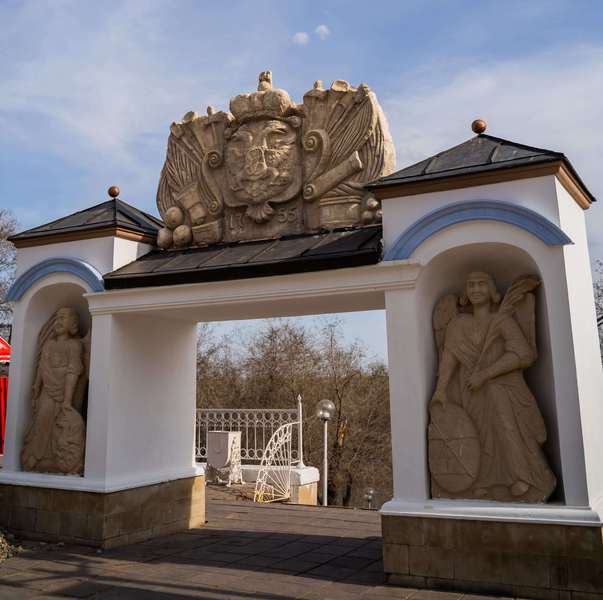
In front of you is the Elizabethan Gate. Undoubtedly, you have already noticed the faces of the figures placed in the niches of the stone columns. High cheekbones, Asian slit eyes, a headband and strands of heavy hair. He holds palm branches and round shields in his hands. But you don't notice the wings on your shoulders right away.
In 1755, Empress Elizabeth granted these gates to the governor of Orenburg, Ivan Neplyuev, for the rapid suppression of the Bashkir uprising. The gift should have been directed towards the steppe, so that any nomad would remember how disobedience and rebellion end. Moreover, the state emblem of the Russian Empire, placed on top, is surrounded by symbols of military power: cannons and cannonballs, guns and axes.
After the Orenburg Fortress was abolished as unnecessary, the Empress's gift was moved from the rampart to the embankment to decorate the descent to the Urals.
Take a photo as a souvenir and continue to the Orenburg History Museum building.
4. Orenburg History Museum
The building of the most famous museum in Orenburg was built in 1856 to house an archive and a money storeroom, and it was built by Ivan Skalochkin, a talented self-taught fortress architect. The place for the construction was determined by the fact that earlier there was a money storeroom with a cellar. The small and narrow windows were planned so as not to disturb the documents in the archive, and the thick walls were supposed to save the city money. But the military took a liking to the building, and in 1857 they adapted it into a guardhouse, which remained so until 1974. There was a guard in one part, and cells for prisoners who violated military discipline in the other.
The museum has more than 8 thousand exhibits. Here they will tell about Pushkin and the multinational Orenburg, about the founding of the city - its difficult history, its formation and flourishing, its citizens and significant events.
You might have noticed a monument at the entrance to the museum. To whom is it dedicated?
5. Monument to Pushkin
The Pushkin monument, opened in 1982, initially attracts more attention than the building it is located in. In fact, it can be viewed for a very long time and with pleasure. Depending on the lighting, it seems that the poet's facial expression changes. Check it out for yourself or watch those who are looking at Pushkin not far from you.
Many people pay attention to the fact that the size of the sculpture's legs and arms is allegedly too large in relation to the entire composition, and the right leg looks longer than the left. However, no one undertakes to measure, most likely just out of respect for the sun of our poetry.
It is because of this monument that residents of the city often call the museum of the history of Orenburg "Pushkin".
Then you will have a short walk around the city. Follow the instructions in the app and keep an eye on the map.
6. Bust of I. I. Neplyuev
Ivan Neplyuev was a disciple and follower of Emperor Peter I and the first governor of Orenburg. During the 16-year rule of the region, Neplyuev, in order to protect the borders of Russia, founded 70 fortresses, carried out reforms in the troops, including in the Orenburg Cossack army.
By the 270th anniversary of the city, the bust of the founder and first governor of Orenburg region was reconstructed, supplemented with a colonnade with two bronze plaques: the first tells about the most important events in the life of the city, the second - the biography of Neplyuev himself. At the base of the column is a capsule with earth brought from Ivan Ivanovich's homeland in the Leningrad region — the village of Bolshoy Navolok.
Go further along Sovetskaya Street, there will be a park to your left. Our next stop is in the center of this square.
7. Monument to Pushkin and Dahl
In the center of the square there is a monument to Pushkin and Dahl, which immortalized the meeting of two great people in our city in 1833. Pushkin came to Orenburg to collect materials for the "History of the Pugachev Rebellion." Vladimir Ivanovich Dahl accompanied him on a trip to the village of Berdy, introduced him to the locals, and took him to the sites of the Pugachev events.
The monument was opened in 1998 on the eve of the 200th anniversary of the poet's birth. When creating the sculpture, Nadezhda Petina depicted Alexander Sergeevich Pushkin in a top hat in order to balance the figures and bring the composition into harmony.
The monument was not installed in a random place – it was here that the Peter and Paul Church was located, where Pushkin and Dahl visited! The temple was destroyed in the thirties, and a Greek cross was erected at the base of the monument in memory of him.
8. To the heroes of the First World War
The six-meter-high stele, crowned with the double-headed imperial eagle, perpetuated the memory of soldiers, officers, Cossacks and generals who went to the First World War.
The installation of the monument is dedicated to the 100th anniversary of the outbreak of the First World War. Then, during the war years, more than 160 thousand people from the Orenburg province went to the front, of which 30 thousand were Cossacks.
The place for the monument was not chosen by chance. The territory of the square at that time belonged to St. Nicholas Cathedral, where in 1914 prayer services were held in honor of victory over the enemies and for the glory of Russian weapons.
The city administration plans to install memorial plaques next to the monument with the names of Orenburg residents who participated in the First World War and perpetuate the names of all now–forgotten soldiers.
Walk further along the square, do you see a monument depicting a horseman on a horse? That's where you're going.
9. Monument to the Orenburg Cossacks
We have come to the monument to the Orenburg Cossacks. It is one of the tallest monuments in the city, with a height of about 13 meters. The Cossacks themselves initiated its construction, and the Orenburg delegation traveled to Moscow several times to monitor the process.
When creating the monument, the personal archives of the Orenburg Cossacks were used, the photographs of which preserved unique evidence of that time.
At this very place, families lived in 249 houses - almost a thousand people. When Pugachev's troops marched on Orenburg, the owners, leaving, burned down their houses so that the rebels could not use them during the siege. Can you imagine what kind of people they were who burned down their house for the sake of common salvation? The warriors whose descendants immortalized their feat with this monument. Did you know that you can use a horseman to determine the cardinal directions? Which way is he looking?
10. Holy Dormition Convent
Here is the Holy Dormition Orenburg Convent. Its history officially began in 1866, when the women's community was opened. Its founder– Tatiana Amartseva, has come a long and difficult way to make her dream come true. It took her 12 years to do this, and in 1872, the small women's community was renamed the Orenburg Dormition Cenobitic Monastery.
It gradually grew and expanded. First, there is a small house with a stove and a room for gardening equipment. Then there was a room for the first temple and workshops, where the nuns sewed blankets and knitted down shawls. By the way, the down shawl of the novices of the monastery was awarded a bronze medal at the World's Fair in Chicago in 1899.
The Church of the Assumption of the Blessed Virgin Mary was designed by architect Konstantin Ton. Do you know which famous temple is also his creation?
11. Church of the Kazan Icon of the Mother of God
The Church of the Kazan Icon of the Mother of God is the largest church in Orenburg and the Orenburg region.
The mysterious history of the Kazan Icon of the Mother of God begins in ancient times and reaches our days. In 1579, a fire in Kazan destroyed part of the city. After this tragic event, the Mother of God appeared to nine-year-old Matrona Onuchina in a dream and ordered Her icon to be dug up in the ashes. An icon was indeed found at the specified location.
This church of the Kazan Icon is not the first in Orenburg. The previous one was blown up in 1932. After almost 70 years, the construction of a new temple complex was planned. On April 7, 2011, on the feast of the Annunciation of the Blessed Virgin Mary, the crosses of the Kazan Cathedral were consecrated and the domes were raised. By the way, take a closer look at them, can you count how many domes the temple has?
This temple has 17 domes, the largest of which weighs 16 tons. And the height of the cathedral, together with the cross, is 55 meters – almost like a 20-storey building! Go inside and inspect the interior of the temple.
This concludes our tour. Now you can visit the temple and relax after a walk.
Have a nice day!
Read completely
Route on the map
-
1. Moving Memorial
-
2. The "Europe – Asia" Bridge
-
3. The Elizabethan Gate
-
4. Orenburg History Museum
-
5. Monument to Pushkin
-
6. Bust of I. I. Neplyuev
-
7. Monument to Pushkin and Dahl
-
8. To the heroes of the First World War
-
9. Monument to the Orenburg Cossacks
-
10. Holy Dormition Convent
-
11. Church of the Kazan Icon of the Mother of God